

The biggest IPO in history crowned the world’s first trillionaire — and, for a moment, the company was worth more than Amazon or Microsoft. Then, from that peak, it shed nearly a third of its value in about a week.
Same company. Same month. So what is it actually worth?
Here’s why nobody agrees. You think you bought a rocket company. But the rockets lose money on purpose. The profit comes from internet beamed out of space. And the company just bought an AI lab whose supercomputer now earns rent from its own rivals.
One ticker — SPCX. Three businesses. Three futures.
I’m Uncle Alpha, and this is a full teardown. Quant-trained, simply explained. By the end, you’ll have taken a trillion-dollar price tag apart, account by account — and you’ll own a tool you can run on any stock that looks too expensive to make sense.
Quick note: this is educational, not financial advice. SpaceX is used as a case study, not a recommendation. Figures come from the S-1 and company disclosures, as of June 29, 2026 — all approximate.
▶️ Prefer to watch? Full video breakdown:
Account #1 — Starlink, the toll road in the sky
Here’s what almost everyone gets wrong about SpaceX: the rockets are the show, but the rockets don’t pay the bills.
This does. Starlink is a network of roughly ten thousand satellites beaming internet where cables never reached. By June 2026: 12 million subscribers across 160-plus countries. Last year it brought in $11.4 billion — about 61% of the whole company — growing nearly 50%.
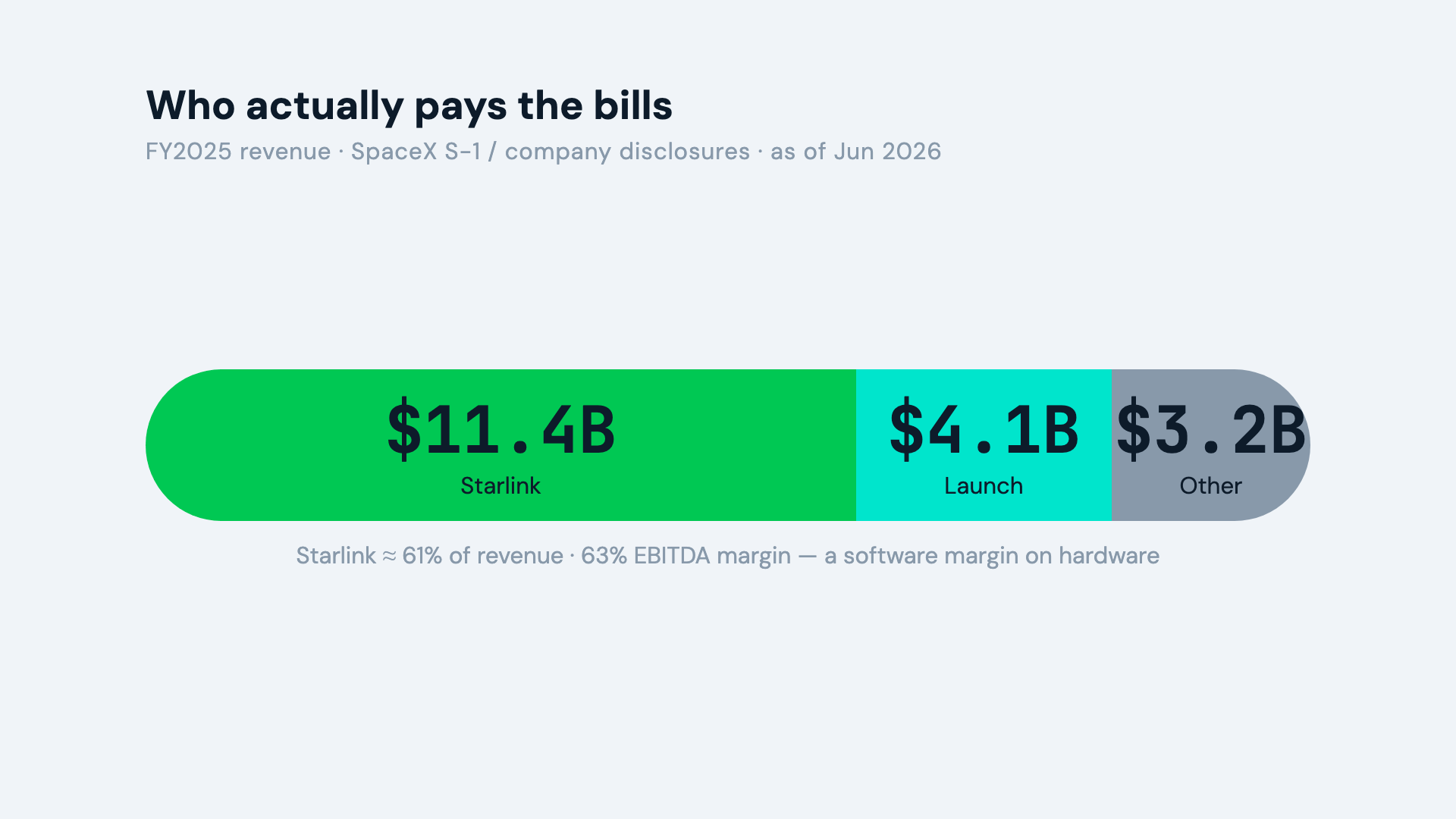
And think about the model. You launch the satellites once; customers pay every month, forever. It’s a toll road in the sky — and the tolls are rich: a 63% cash-profit margin. For a business that builds and launches hardware, that’s a software company’s margin. It’s why SpaceX can pour money into rockets and AI and still keep the lights on.
The two-curve check
Now a tool for any subscription business: watch two numbers at once.
Starlink’s subscribers are doubling. But revenue per user is falling — from $99 a month in 2023 to about $66 by 2026. Not because anyone’s bill got cut, but because the next million customers aren’t in rich cities; they’re in places paying $10 to $30 a month.
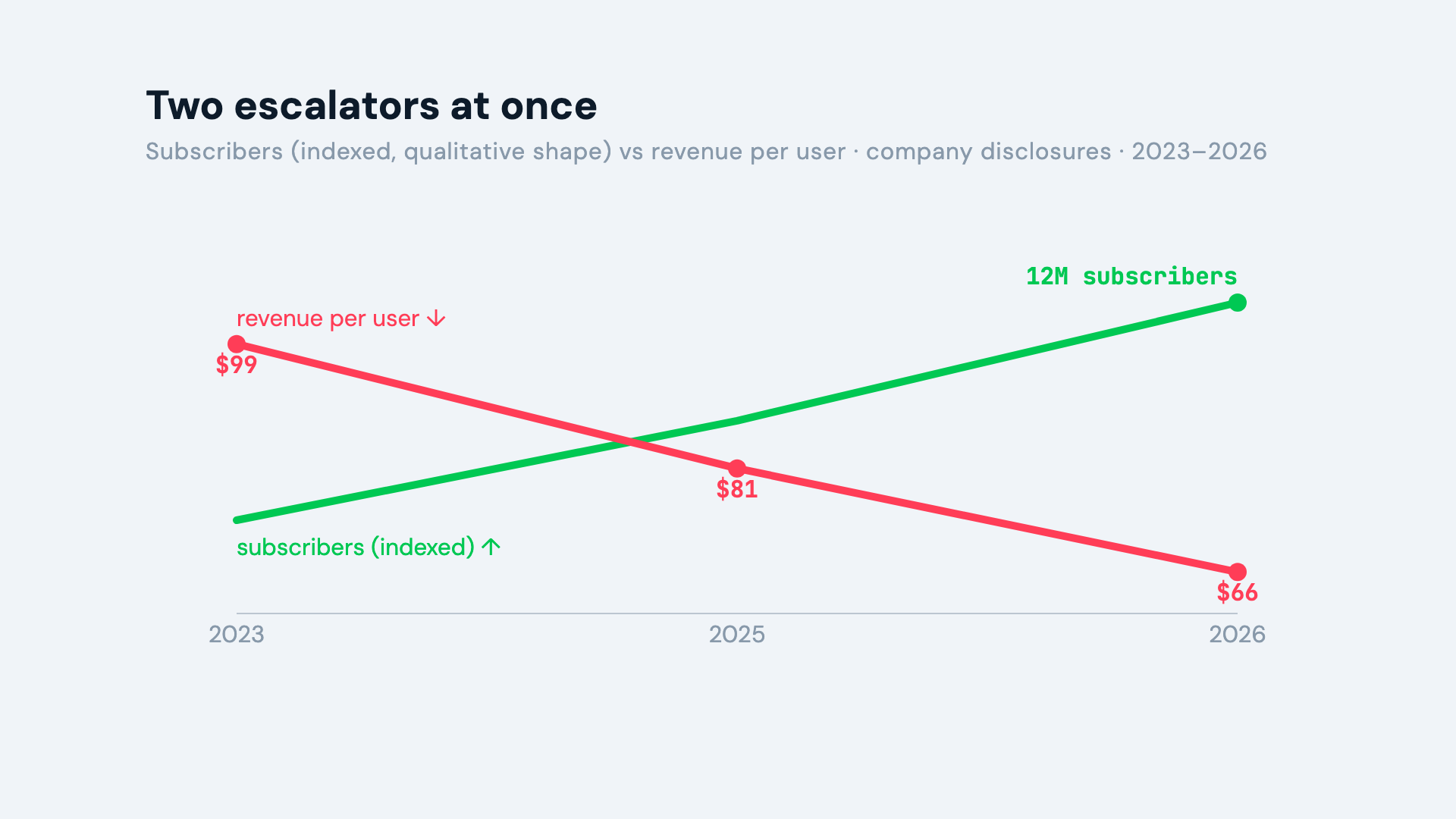
So Starlink rides two escalators at once — more users, less per user. Lay those two curves over any subscription company, and you’ll see the story the subscriber count hides.
One catch before we move on: the next-gen V3 satellite carries ten times the capacity — but it’s too big for the old rockets. It only flies on Starship. Starlink’s future is bolted to the boldest bet in the company. Hold that thought.
Account #2 — Rockets: count the dollars, not the trips
In 2025, SpaceX launched 165 times — a flight every other day, about 85% of U.S. orbital launches, nearly double all of China. The most dominant rocket in history.
That launch business pulled in $4.1 billion — and poured almost all of it into building the next rocket: $3 billion into Starship in one year. On paper the division shows a small operating loss. Don’t misread it: this isn’t a business that can’t make money — it’s one choosing to spend itself to zero, on purpose, to fund the next leap.
Here’s the tool that keeps you from being fooled by big activity numbers: look past the count, and ask who actually paid for the seat.
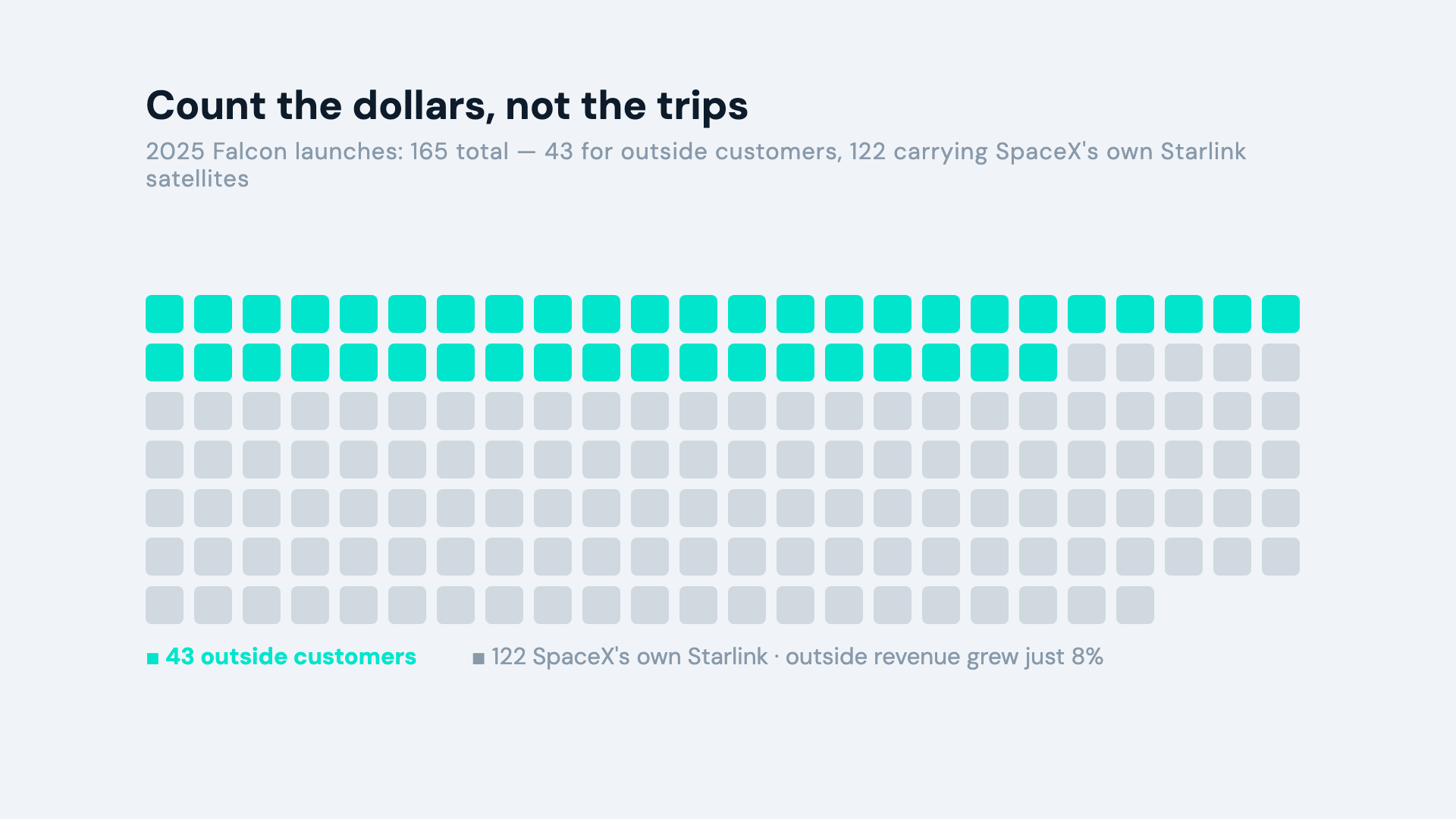
Of those 165 launches, only 43 were for outside customers. The rest? SpaceX flying its own Starlink satellites. That’s not a sale — that’s moving your own furniture and counting the trips. It’s why launches scream record while outside launch revenue grew just 8%. Count the dollars, not the trips.
So why bet the farm on an unfinished rocket? Because Starship is the keystone. Every growth story runs through it — the 10x Starlink satellites, the AI satellites, NASA’s Moon landing, Mars. One rocket, three arches. Pull the keystone and all three sag at once.
And here’s the tension that should shape how you read the stock. Starship runs on a physics clock: test, blow one up, learn, fly again. The destination isn’t really in doubt — it’s when, not if. But a share price runs on a Wall Street clock, and Wall Street doesn’t wait for physics. That gap — a near-certain future on an unknowable timeline — is exactly where this stock shakes.
Account #3 — xAI: black hole, or glue?
The strangest account of the three didn’t just lose money last year. It lost so much it pulled the whole company underwater.
Take out the AI division, and SpaceX made about $3.8 billion. Add it back, and the company swings to a $2.6 billion operating loss. One segment — a $6.4 billion operating loss — ate everything the rockets and satellites earned. The brilliant kid who runs up a bill bigger than the family’s whole income.
Why pour that in? An arms race. xAI built one of the largest supercomputers on Earth — $18 billion of chips — to chase the lead in AI.
Then came the twist, the sharpest fact in the whole story. Demand for Grok didn’t keep up with all that hardware. So SpaceX — now xAI’s parent — moved xAI’s training onto its newest machine and leased the older one out. To whom? Anthropic and Google — its direct rivals. Over a billion dollars a month from one; nearly a billion from the other.
A machine built to beat the competition now pays its bills by renting to the competition. Failure, or genius? Bears say it proves xAI can’t win the model race. Bulls say it’s the Amazon move — spare computers becoming a cloud business. Both can be true.
xAI’s real shot was never a slightly better chatbot — four labs are trading punches and nobody’s landed a knockout. Its shot is to become the brain inside Musk’s machines: Grok inside a Tesla, inside the Optimus robot, riding on Starlink, reading X in real time. That’s what a pure software lab doesn’t have — a body, a fleet, and a firehose of real-world data.
A reminder: everything in this section is a bet, not a guarantee.
The bill: what the $1.75 trillion IPO assumes
Put the company back together. One engine — Starlink, the only part that reliably makes money. Two bets on top — Starship, the keystone everything depends on; and xAI, the black hole that might just be the glue.
Is $1.75 trillion fair? Depends who you ask. At the IPO, investors paid roughly 95–110× the company’s total sales — closer to 150× on Starlink alone, the part that actually earns. Among the most expensive megacap debuts ever. Morningstar’s fair value estimate: about $780 billion — less than half.
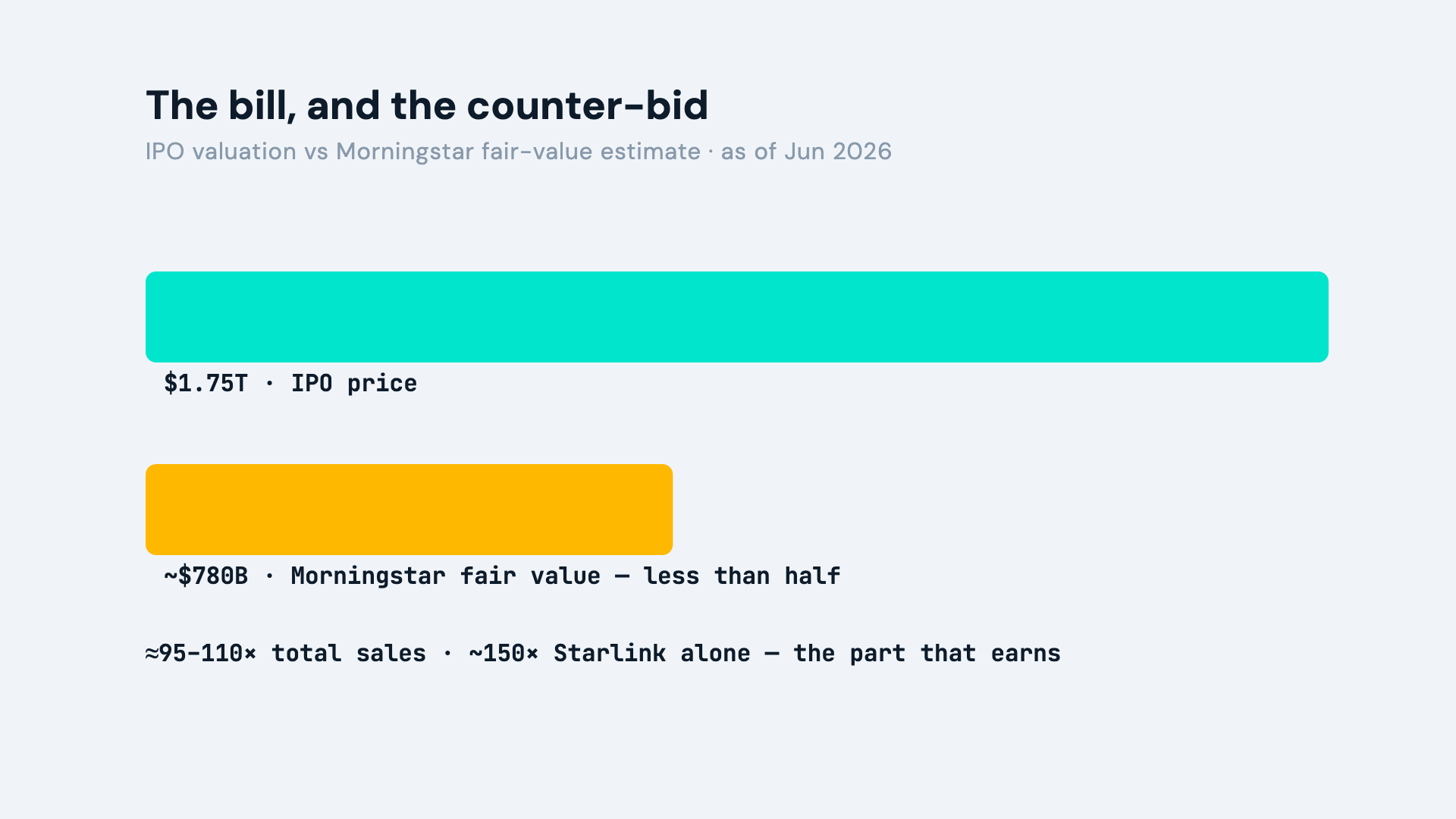
Bears say everything above the engine is hope. Bulls say you’re not buying 2026 — you’re buying 2030, when Starlink’s everywhere, Starship’s cheap, and the AI has a body. I won’t tell you who’s right. I’ll show you what they’re arguing about: the bets, not the engine.
One footnote that matters. The shares you can buy get one vote; Musk’s get ten. He keeps about 85% of the voting power. You’re buying a ticket on the rocket — not a seat in the cockpit.
The tool you take with you
Separate what a company does today from what it might become. You pay for today with analysis. You pay for tomorrow with faith.
The framework is real. The vision is real. The timeline is anyone’s guess — and that gap, between a destination that looks certain and an arrival time nobody can pin down, is why this stock swings the way it does. The volatility isn’t a glitch. It’s the receipt for a story this big.
So here’s the whole tool: whenever a price looks insane as one number, break it into accounts and ask which ones you believe. You’re never really buying “SpaceX” — you’re buying one toll road plus two bets, at a price that assumes both bets pay off.
Aim right. Stay long.
— Uncle Alpha
Quant-trained, simply explained.
▶️ Watch the full breakdown on YouTube:
*For educational purposes only. Not financial advice, and not a recommendation to buy, sell, or hold any security. SpaceX (SPCX) is an educational case study. Figures are approximate, from the S-1 and company disclosures as of June 29, 2026. Past performance does not guarantee future results. Full disclaimer: unclalpha.com/disclaimer